
WIRELESS INTERCOM System for Hazardous Environments
Hands-free, Full-Duplex communication
Engineered for Level A and Level B protective equipment, SCBA, PAPR, and CAPR environments across nuclear, chemical, aerospace, and industrial facilities.
The C-AT Wireless Intercom System has been continuously deployed for more than 13 years
— including sustained 24/7 operations —
at the Blue Grass Chemical Agent-Destruction Pilot Plant and the Pueblo Chemical Agent-Destruction Pilot Plant.
Encapsulated hazmat suits create communication conditions that conventional radios and general-purpose wireless headsets were never designed to address.
The C-AT Wireless Intercom System (WIS) is engineered specifically for Level A and Level B protective equipment, enabling clear voice communication inside respirators, high-noise industrial environments, and hazardous facilities.
Hands-Free Operation
Designed for use while wearing encapsulated PPE.
Full-Duplex Communication
Detect man-down emergencies immediately.
Hazard-Ready Design
Engineered for high-noise, high-moisture environments.
Interoperable Architecture
Scalable to Integrate with facility systems and incident command radios through the ICRI.
Made in America
Clear communication
when hazardous operations leave
no margin for error.
Communication Inside Hazmat Suits Is Fundamentally Different
Personnel operating inside Level A and Level B hazmat suits experience communication challenges that conventional radios and facility intercom systems were never designed to address.
Encapsulated PPE environments introduce:
- continuous airflow noise from PAPR and CAPR respirators
- speech distortion from SCBA masks
- high-decibel industrial background noise
- condensation and heavy perspiration
- limited dexterity for small radio controls
In these environments, clear communication becomes a safety-critical requirement.
Most wireless communication systems rely on microphones that capture airborne speech.
Inside encapsulated protective equipment, respirator airflow, mask materials, and industrial noise often degrade traditional microphone performance.
The WIS uses accelerometer-based throat microphones that detect vocal cord vibration directly, enabling intelligible communication even when airborne speech is heavily distorted.
The C-AT Wireless Intercom System (WIS) was developed specifically to support communication inside hazmat suits.
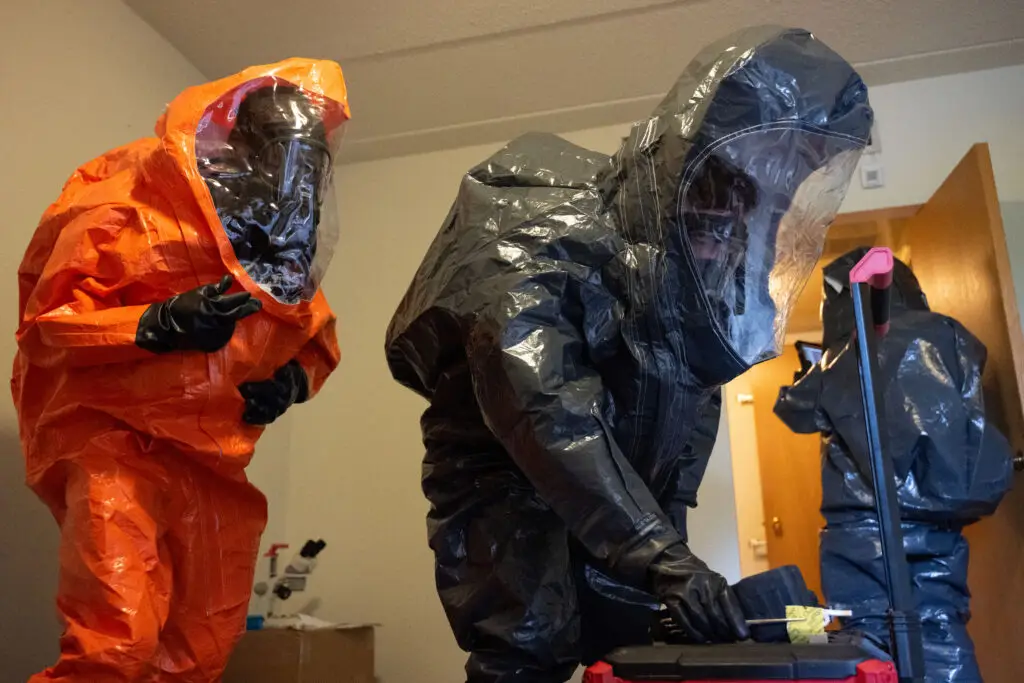
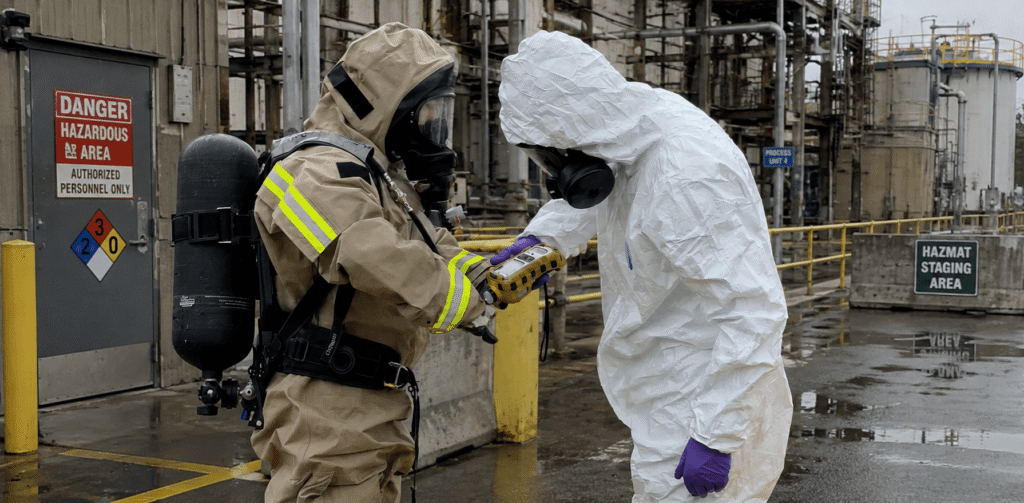

Hazmat Suit Communication System
Operational Environment
Clear communication for personnel wearing Level A and Level B hazmat suits.
WIS supports teams performing hazardous operations inside encapsulated PPE where respirators, masks, and industrial noise make communications with conventional radios unsafe and unreliable.
Voice Capture Technology
WIS uses a vocal cord vibration accelerometer-based throat microphone that detects vocal cord vibration instead of airborne sound. Traditional microphones rely on airborne sound.
This enables absolute communication despite:
• respirator airflow from PAPR, CAPR, and SCBA systems
• speech distortion from respirator masks
• high-noise industrial environments
Communication Modes
WIS supports two IN SUIT communication modes depending on operational requirements.
Full Duplex
Continuous hands-free communication for personnel operating in hot zones.
Half Duplex (Big Button PTT)
Large push-to-talk controls designed for protective gloves, commonly used in airlock or support areas.
Operators select the communication mode before entering the suit, based on facility procedures or the radio connected to the system.
Operational Environments: WIS supports hazardous PPE communication across multiple sectors:
- Nuclear facility maintenance and containment operations
- Chemical processing and demilitarization
- Hydrazine and hydrogen fueling operations
- Industrial plant shutdowns and hazardous maintenance
- Emergency hazmat response operations
WIS Deployment Configurations
In-Building WIS
Permanent Communication Infrastructure for Hazardous Facilities including:
Nuclear Containment Structures
Chemical Processing Facilities
Turbine Halls
Hazardous Maintenance zones
Rocket Fueling Facilities
Includes control room and suit-up area communications.
Portable WIS
Rapid-deployment Communication for:
Hydrazine Fueling Bays
Industrial Shutdowns
Confined Space Entries
Emergency Hazmat Operations
Uses portable repeaters to establish coverage where permanent infrastructure is unavailable.
Interoperability with Incident Command
WIS systems can be stacked with the ICRI interoperability platform
to connect suit personnel with:
Incident Command Radio Networks
Facility Operations
Emergency Responders
Mission Control Operations
Proven in Chemical Weapons Destruction Facilities
The C-AT Wireless Intercom System in operation continuously for 13+ years
– including sustained 24/7 operations –
at two U.S. chemical weapons destruction facilities:
Blue Grass Chemical Agent-Destruction
Pilot Plant (BGCAPP)
Pueblo Chemical Agent-Destruction
Pilot Plant (PCAPP)
The WIS supports communication for personnel working in
control rooms
suit-up areas
decontamination stations
hazardous work zones
Including teams operating in
Level A and Level B PPE
This long-term deployment demonstrates the system’s reliability in demanding hazardous environments.
Procurement & Government Purchasing
Government agencies can procure C-AT systems through multiple streamlined acquisition paths, including:
• Cooperative purchasing contracts
• P-Card purchasing
• Government acquisition programs including GSA
• Blanket Purchase Agreements (BPA)
• Task orders under IDIQ contract vehicles
• Grant-funded and program-funded procurement
• Compliance-ready purchasing options
C-AT systems may also be procured through engineering integrators and facility contractors, and the company can support programs as either a prime contractor or subcontractor depending on project requirements.
C-AT supports rapid procurement and deployment for time-sensitive missions, facility upgrades, and emergency response operations.