
Connect up to 10 radios and 14 total audio devices for command vehicles, emergency operations centers,
field command posts, and large-scale incident coordination. Commander Elite is the high-capacity ICRI platform
for agencies that need more radios, more devices, and more structured communication control than Operator Pro provides.
This is the platform for incidents where communication cannot depend on a single patch, a single channel, or a single agency system.
Commander Elite is built for agencies that already have communications systems but still have gaps when multiple agencies arrive at once.
Supports higher-capacity communication management than field-level interoperability systems.
The Incident Commander assigns radios and voice devices to talk groups and can change them on the fly.
Built for command vehicles, EOCs, large incidents, and structured multi-agency operations.
Supports radio, trunked radio, PTToC, cellular, satellite, VoIP, SIP, mesh-connected audio, and dispatch-connected audio.
Some incidents become chaotic immediately. A bridge collapses. A major fire cuts through a city block. A large transportation incident triggers local, state, and federal response. Multiple agencies arrive with good systems that still do not fully connect.
That is where Commander Elite fits.
It is designed for incidents where:
Multiple agencies need to communicate at the same time
Communications must be separated by role or mission
Command needs to control and adjust talk groups quickly
The communications plan changes with the incident
Commander Elite can function as a direct patch when needed, but that is not the primary reason agencies buy it.
Agencies buy Commander Elite when they need a centralized interoperability hub for large-scale, multi-agency coordination.
Commander Elite is a 10-radio interoperability platform and a high-capacity radio interoperability gateway that connects radios and voice devices into one controlled communication environment. Operates as a unified voice layer across radios, networks, and communication systems.
→ Multi-agency scale: Connect more agencies and more systems at once
→ On-the-fly changes: Move radios and devices between talk groups quickly
→ Unified mission support: Support command, operations, support, logistics, and external coordination AT THE SAME TIME
→ Talk group control: Assign radios and devices to different talk groups
→ Encrypted coordination: Keep encrypted systems on the same talk group when required
→ Remote management: Manage communications from the scene or from an off-site control point
This is not just more ports. It is more control over how communications are organized, grouped, and adjusted during large-scale incidents.
Commander Elite supports interoperability across operational environments. Connects radio, cellular, VoIP, SIP, and satellite voice systems. Enables direct participation from smartphones, dispatch, and remote users. Supports cross-band, cross-platform, and cross-encryption communication.
Communications routed through the system can be monitored, managed, and accessed as active communication resources without replacing the systems the agency already uses. Supports walk-up radio integration on the fly and radio integration without reconfiguration. Commander Elite supports command vehicle interoperability and EOC interoperability for agencies managing large incidents, continuity events, and multi-agency response from a centralized coordination site.
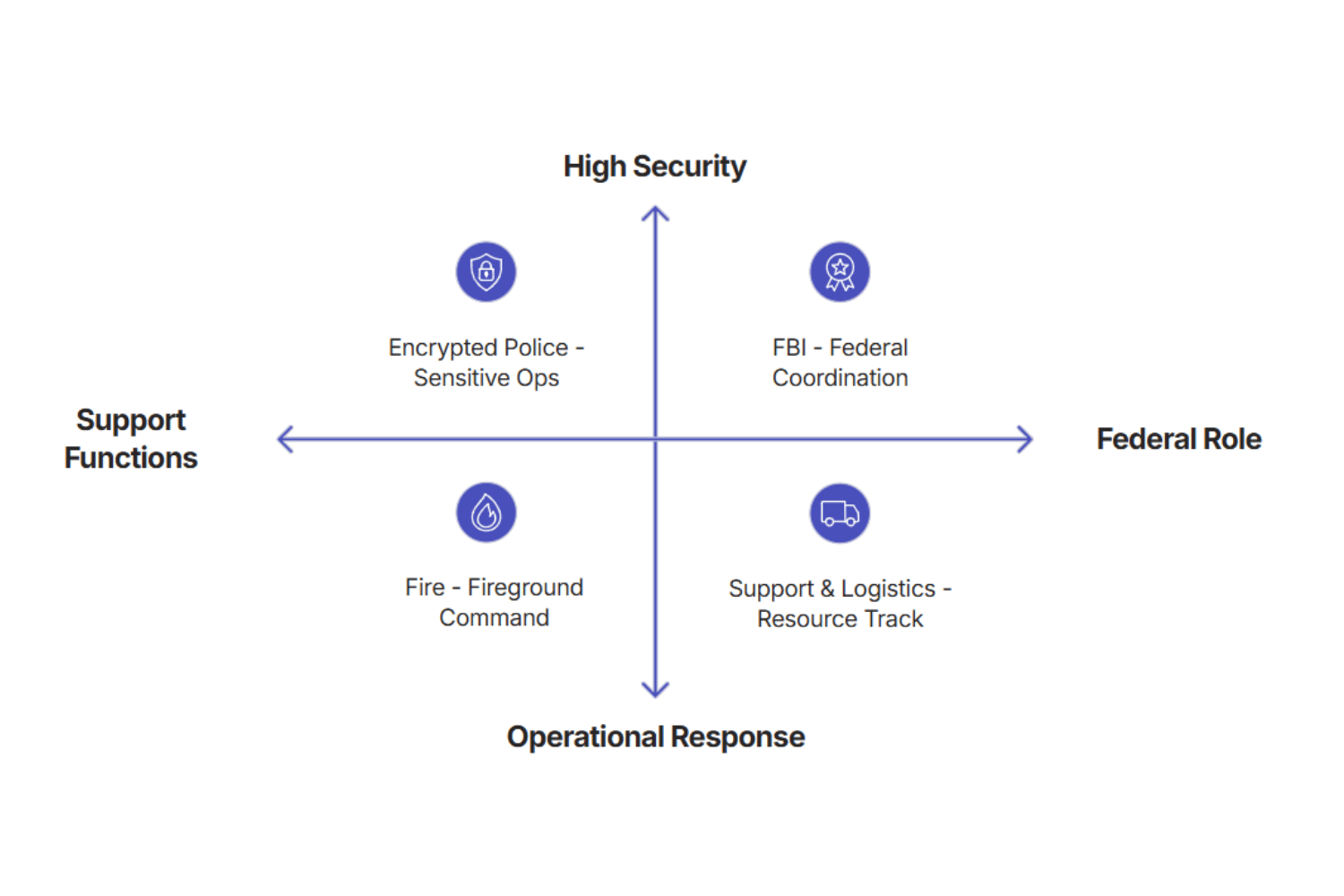
Those assignments are not fixed. They can be changed on scene and remotely.
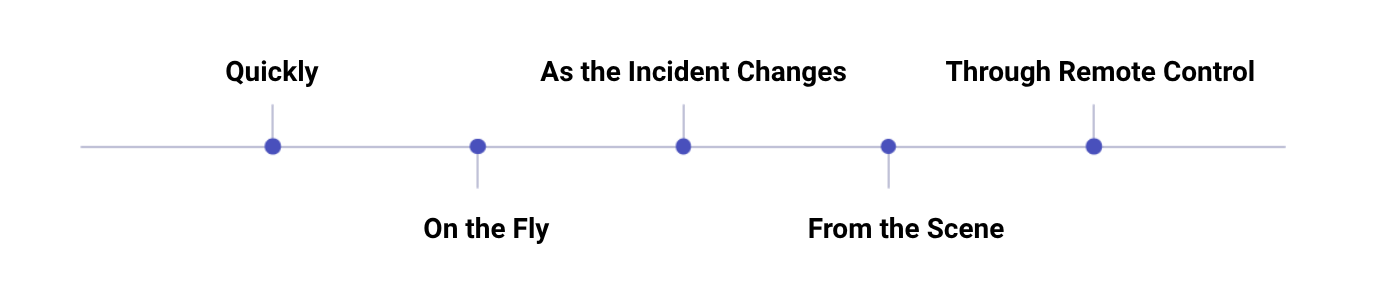
This enables agencies to maintain structure while still adapting the communications plan in real time.
Devices can be assigned, separated, regrouped, and reassigned without rewiring or radio reprogramming.
No rewiring. No delay. No dependency on external personnel.
Commander Elite supports a Remote Talk Group Control Interface built for higher-capacity coordination.
View: See active talk groups in
real time.
Create: Add or modify talk groups as needed.
Reassign: Move radios, sat phones, and VoIP users.
Adjust: Separate or combine communication groups.
Monitor: Track active communications continuously.
All-Call: Reach all connected users at once.

The on-scene command structure remains primary. The Incident Commander retains full control and can override or remove remote access at any time.
Multiband radios let one user access multiple bands. Commander Elite connects multiple users, multiple agencies, and multiple systems into one communication environment.
Multiband radios let 1 user access multiple bands.
Commander Elite connects MULTIPLE users, MULTIPLE agencies, and MULTIPLE systems into one communication environment.
A connected handset or headset gives command a direct voice point into the full communication environment – no separate path required.
A mobile phone or PTToC app or SIP telephone can be called from anywhere and bridged directly into active talk groups.
Command can monitor, participate, and coordinate across all active communication paths from off-site.
All field users remain on their native systems – nothing changes for them.
Command stays in command – from anywhere.
Commander Elite supports VoIP integration, including SIP support, for IP-based voice environments.
Commander Elite can be purchased with VoIP capability, including SIP support, for integration into IP-based voice environments, command vehicles, emergency operations centers, and other network-connected communication systems.
Commander Elite supports PTToC integration for agencies operating broadband push-to-talk alongside LMR systems.
Broadband push-to-talk users can be brought directly into the active interoperability environment.
Land mobile radio and broadband push-to-talk users operate together without forcing a single device type.
Agencies keep their existing devices and still participate in the unified communication environment.
Commander Elite integrates with MESH and MANET environments using donor radios. This enables mesh-connected audio to be brought into the interoperability platform and bridged to other communication systems.
Commander Elite does not manage the network itself. It keeps communication across those systems usable and connected.
Donor radios serve as the bridge point, allowing MESH and MANET audio to enter the Commander Elite environment and be routed to other connected systems. Without requiring changes to the MESH network itself.
Commander Elite supports Trunked Radio participation through donor radios. This enables agencies to bring trunked systems into the interoperability plan WITHOUT changing infrastructure.
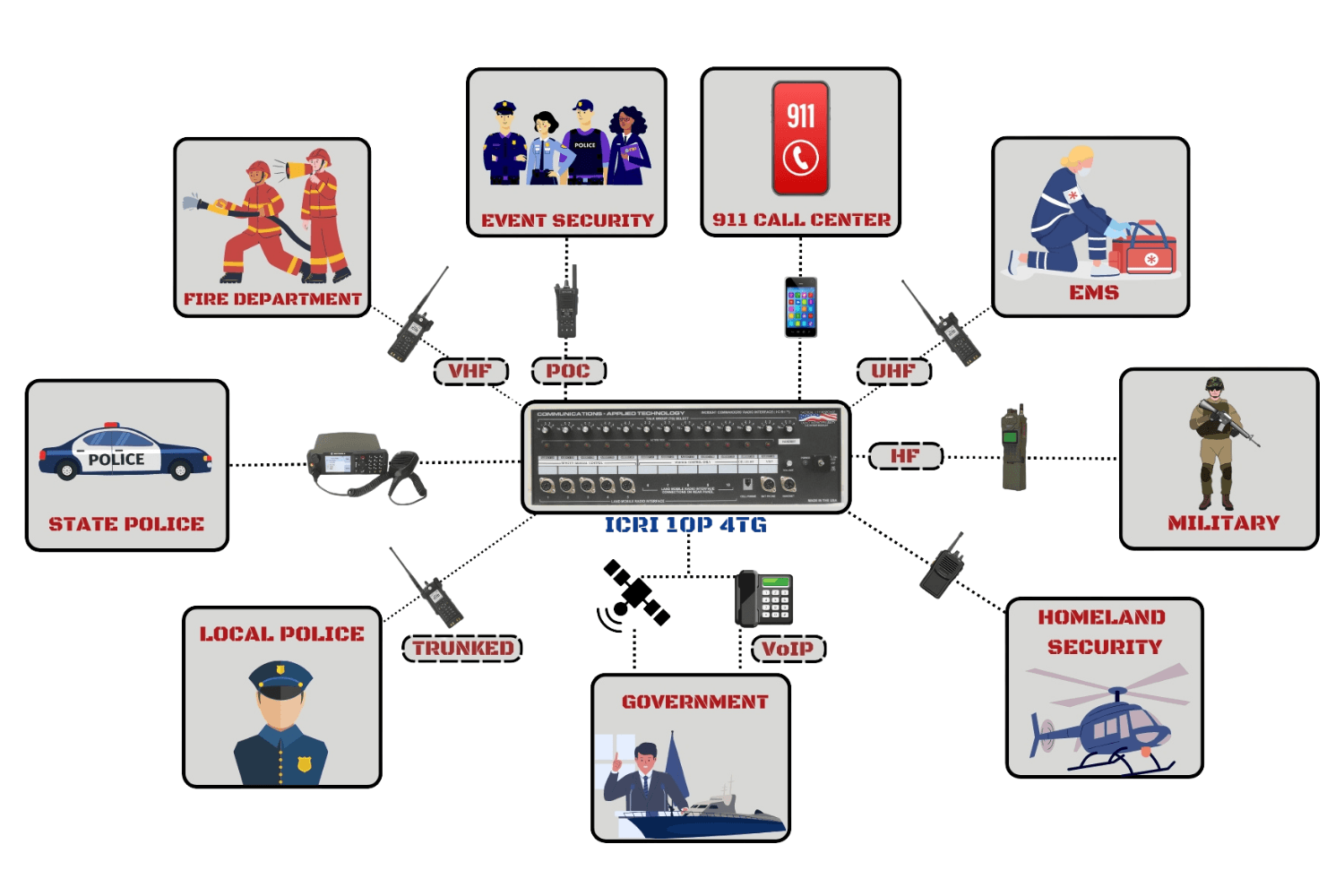
This is useful in incidents where trunked system users, conventional radio users, PTToC users, satellite users, and command-level voice systems all need to communicate in the same operational environment.
Supports monitoring, distribution, and external recording of all communication paths.
Command-level visibility across active communication paths without interrupting operations.
External recording system connection supports documentation and review during extended or complex incidents
VOX-enabled telephony ports automatically activate voice transmission, and PTT-controlled radio interfaces maintain standard RF operation.
Commander Elite is designed to integrate into existing communication systems and expand their capability. Builds on what teams already have, adding capability where it is needed. Commander Elite supports radio-agnostic interoperability across mixed manufacturers, bands, and system types. If the device has audio and the correct cable interface, it can be integrated into the communication environment.
It can integrate into:
Fixed command and communications systems
PTToC and network voice environments
Walk-up radio environments in command vehicle and field interoperability settings
This is important for agencies with limited budgets or grant-driven purchases because Commander Elite gives them one system with multiple deployment and integration options instead of requiring multiple separate systems.
Commander Elite keeps communication control with the people managing the incident.
No dependency on remote technical staff or dispatch to make changes during the incident.
Commander Elite maintains interoperability capability independent of dispatch-built patches
This gives agencies field-controlled operation without dependence on dispatch-built patches or external technical support
Maintains baseline interoperability for baseline interoperability without relying on broadband or external systems.
Operates in degraded, denied, or infrastructure-limited environments where other systems may fail.
When broadband or external systems are unavailable, Commander Elite keeps communication moving.
When broadband or external systems are unavailable, Commander Elite keeps communication moving.
When agencies buy Commander Elite from C-AT, they are getting:
A 10-radio interoperability system with support for 14 total audio devices
Command-level talk-group assignment and reassignment on the fly
Multi-Path Audio
Analog, digital, trunked radios, PTToC, cellular, satellite, VoIP, SIP, dispatch and Mesh audio
Rack-Mount and Guardian – ONE system for command vehicles, fixed installations, and ruggedized field deployments
Commander Elite also includes command access, remote talk-group control, and command vehicle / EOC integration. It is preconfigured for rapid deployment without programming in the field.
More radios, more agencies, and more control when incidents escalate.
One system that can be used in command vehicles, fixed installations, and ruggedized field deployments – without requiring separate systems for each environment.
This is the first system on scene, not a backend solution.
No recurring subscription required to maintain baseline interoperability capability.
One platform with multiple deployment options reduces the need for separate interoperability systems.
What This Means for Agencies
Centralized Interoperability for Large-Scale Incidents and Command Vehicle Integration
Centralized interoperability hub for command vehicle integration, emergency operations center communications, large-scale incident coordination, and long-duration operations.
Capability Overview
The Commander Elite Rack-Mount integrates directly into existing communications infrastructure and provides centralized command and control communications for high-capacity interoperability operations. It is more suitable for large-scale incidents where multiple agencies, communication groups, and operational roles must be managed from a command vehicle, EOC, or fixed site.
Always-on interoperability for command vehicles, EOCs, and fixed command environments.
Ensures secure and stable integration with a variety of communication systems, supporting cross-band interoperability.
Centralized interoperability hub with command vehicle integration
Best for
Can interface with Starlink transport paths for long-haul communications.
Can integrate with CSCK for underground and RF-denied continuity operations.
Capability Overview
The Commander Elite Guardian packages the full Commander Elite capability set into a ruggedized, waterproof Pelican deployment case for large-scale field operations. It is built for incidents where agencies need high-capacity interoperability in places a command vehicle cannot go, while still maintaining command-level control, configurable talk groups, and support for multiple voice environments.
Traversable to areas mobile command vehicles cannot reach. Waterproof with the lid closed
Configurable 4TG control with radio, cellular, satellite, VoIP, SIP, and dispatch-connected audio integration
Built for disaster, tactical, defense, and search and rescue operations
For underground, BLOS and RF-denied operations.
Commander Elite is for agencies that already have communications systems and still have interoperability gaps. It is for agencies that need:
Command and Control Communications
Unified Command Interoperability
Mobile Command Vehicle Interoperability
Large-Scale Multi-Agency Interoperability
Disaster Response Communications
Emergency Operations Center Communications
It gives them:
• 10 radios / 14 total audio devices
• Configurable 4TG control
• Centralized command-level interoperability
• Field and off-site talk-group control
• Support for radio, PTToC, trunked donor radios, cellular, satellite, VoIP, SIP, dispatch-connected audio, and mesh-connected voice paths
• Rack-mount and ruggedized deployment options
Used in multi-agency response, disaster operations, continuity events, and critical infrastructure response.
Accessible through established state and cooperative procurement vehicles.
Simplified purchasing via government purchase card for rapid acquisition.
Guidance available for leveraging applicable grant and funding sources.
Identify the right configuration for your operational need
Validate interoperability across your systems
Receive detailed technical and procurement guidance